17 specialized agents. 6 phases from strategy to deployment. Handoffs through files, so context survives the session that created it. Start from an empty folder — or from the prototype you already shipped.
A backend agent makes design decisions it shouldn't. Context disappears between conversations. There's no repeatable process.
You can build faster with AI. But only if the AI knows what it's working on, what it shouldn't touch, and where the last agent left off.
Built and refined across 10+ real projects. Every pain point became a fix.
That's not a knock — moving fast is the right call early on. But when an LLM hits a gap in context, it doesn't stop. It fills the gap with whatever looks right, and those guesses compound. Archflow closes the gaps before code is written, so what you build holds together as it grows.
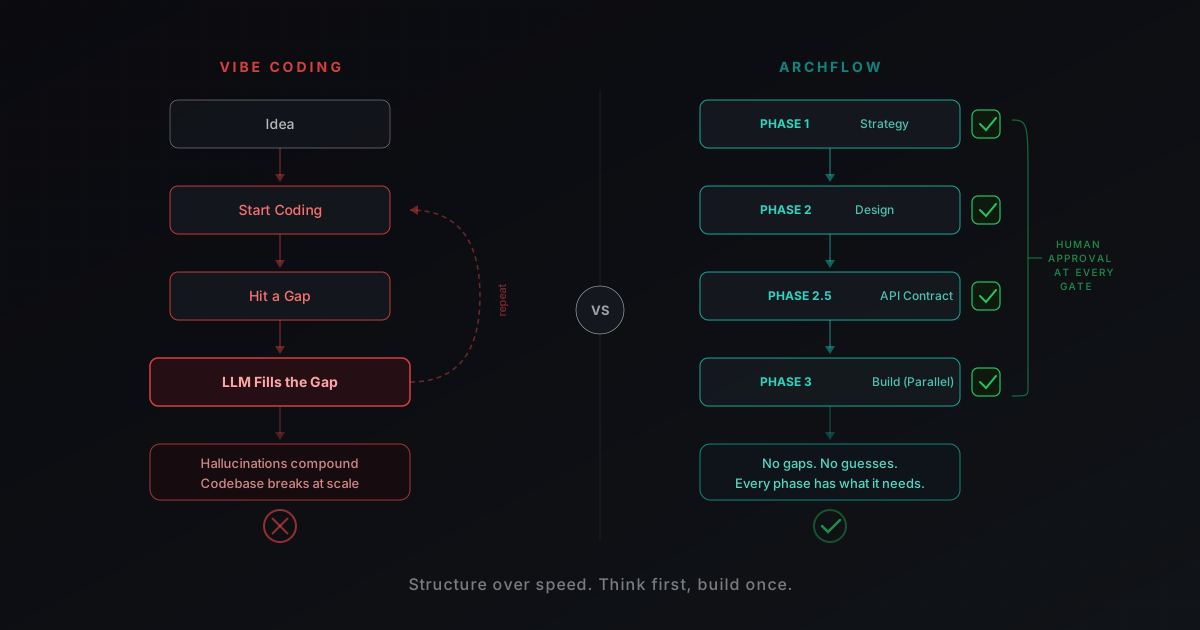
17 agents, each scoped to one domain. A UX designer doesn't write backend code. An API engineer doesn't make design decisions. Deep expertise, not broad awareness.
Agents communicate through artifacts, not chat. The API contract becomes the single source of truth. Frontend and backend build against the same spec. Nothing gets lost between conversations.
6 phases from strategy to deployment. Nothing moves forward without your approval. No skipped steps. No autonomous decisions on what ships.
product-strategist / feature-planner
ux-designer / dsl-generator
api-contract-architect
ui-engineer + api-engineer / qa-engineer
code-reviewer / performance-optimizer
devops-engineer / post-launch-analyst
Each phase loads only what the active agents need. Less noise. More focused results.
Your prototype works. People are using it. What it doesn't have is a roadmap, an API contract, a test plan, or a defensible answer to what 1.0 means.
Onboarding audits what you shipped and reconstructs the plan around it. Where it finds working code with no story behind it, it writes the story and marks it delivered — so your roadmap opens describing reality, not pretending you're on day one.
Then close the gaps that are costing you
Can't decide what to build next
Phase 1 — strategy, personas, KPIs
Every screen looks slightly different
Phase 2 — design system
Frontend and backend disagree about the API
Phase 2.5 — contract both sides build against
Scared to change anything
Phase 3 — tests and acceptance criteria
No idea if it's secure or fast enough
Phase 4 — review and optimization
No repeatable way to ship
Phase 5 — CI/CD, versioning, app store
What this does and doesn't do: you get the plan, contracts, and quality gates your prototype never had, and Phase 4 agents review code quality, security, and performance. Archflow will not silently rewrite your architecture. You decide what gets refactored — it makes sure you know what needs it.
Full guide: taking a prototype to productionMost AI workflows assume you're starting from scratch. This is the step that doesn't — here's exactly what it does to your repo.
Run /archflow:onboard and it dispatches up to 9 agents in parallel. They audit your code, import docs from Jira, Notion, Linear, GitHub, and Slack, reverse-engineer your design system and API contracts, and drop you into the right phase.
Answer 5 questions
Up to 9 agents analyze in parallel
Artifacts generated for your approval
New project? /archflow:init starts you at Phase 1.
Then don't run it. Archflow has two modes over the same schema, and new projects start in the light one.
One implicit release. Gates that record but never block. No ship ceremony until you ask for one. You still get agents, contracts, and phases — without the paperwork.
Explicit release pipeline, enforced readiness gates, role lanes for PM, design, architecture, and QA. Everything a second contributor makes necessary.
Same schema either way, so switching costs nothing. When Archflow notices you've outgrown quick — a second release, a second contributor — it offers the upgrade. It never forces it.
There are eight in total, but this is what the loop actually looks like.
/archflow
Where the project stands, and what to run next
/archflow:feature
Add a story — capture it, or branch and build it now
/archflow:groom
Turn a backlog stub into a ready story with acceptance criteria
Plus, when you need them
/archflow:init
Start a new project at Phase 1
/archflow:onboard
Analyze an existing codebase
/archflow:release
Create, start, and ship releases
/archflow:mode
Switch between quick and full
/archflow:setup-mcp
Connect Jira, Notion, Linear, GitHub
/archflow:migrate
Upgrade a v1.0 project to v2.0
Phases, agents, and roadmap structure adjust based on project type. Set automatically during onboarding.
Free and open source. No lock-in. Uninstall anytime.